What Happens To A Dead/Reincarnated Oba's Head, Heart, Liver Will Shock You!

In Yorubaland, a king (or a queen in some rarer instances) is superhuman. The monarch, known as the Oba, who wears the Adenla (Great Crown) is not seen as an ordinary mortal but as one of the gods, one of the divines, a creature that communes directly with the gods. As a matter of fact, when the Yorubas were so steeped in traditions in the precolonial era, the oba must never reveal his face in public and instead wears the Ade (Crown) or Adenla(Great Crown) with elaborate dangling beads that cover his face.

Ooni tells critics ‘no king on earth is above God’ “I have no regret whatsoever for kneeling down to exalt the almighty God who did not only create me, but also kept me alive, saw me through all the storms in my life-journey and eventually crowned me as the Custodian of Oodua Race''.
A king must also never prostrate or genuflect before anyone, not even his parents (although I see some of them bowing before the Queen of England). But the culture never mentioned not bowing to God, whether in church or mosque. A great speech given by the The Ooni of Ife, Oba Adeyeye Enitan Ogunwusi(Ojaja II)
But that is that, what precisely happens when a king has passed on? Well, what follows is an elaborate process of carefully orchestrated rituals. One, there are two groups of people that must be informed immediately a king dies: the Ajes, Iya Nlas or Awon Iyami Oshoronga (the Great Mothers of the Occult) and the Ogbonis The Ajes are the creators of the kings and without their input, a new king cannot be chosen and the line of succession will be broken. They are summoned to the palace because they are believed to have total control of the secrets of the knowledge of existence and Yorubas believe that the Ajes know a reigning king will die and how to make plans for the new one.
But that is that, what precisely happens when a king has passed on? Well, what follows is an elaborate process of carefully orchestrated rituals. One, there are two groups of people that must be informed immediately a king dies: the Ajes, Iya Nlas or Awon Iyami Oshoronga (the Great Mothers of the Occult) and the Ogbonis The Ajes are the creators of the kings and without their input, a new king cannot be chosen and the line of succession will be broken. They are summoned to the palace because they are believed to have total control of the secrets of the knowledge of existence and Yorubas believe that the Ajes know a reigning king will die and how to make plans for the new one.
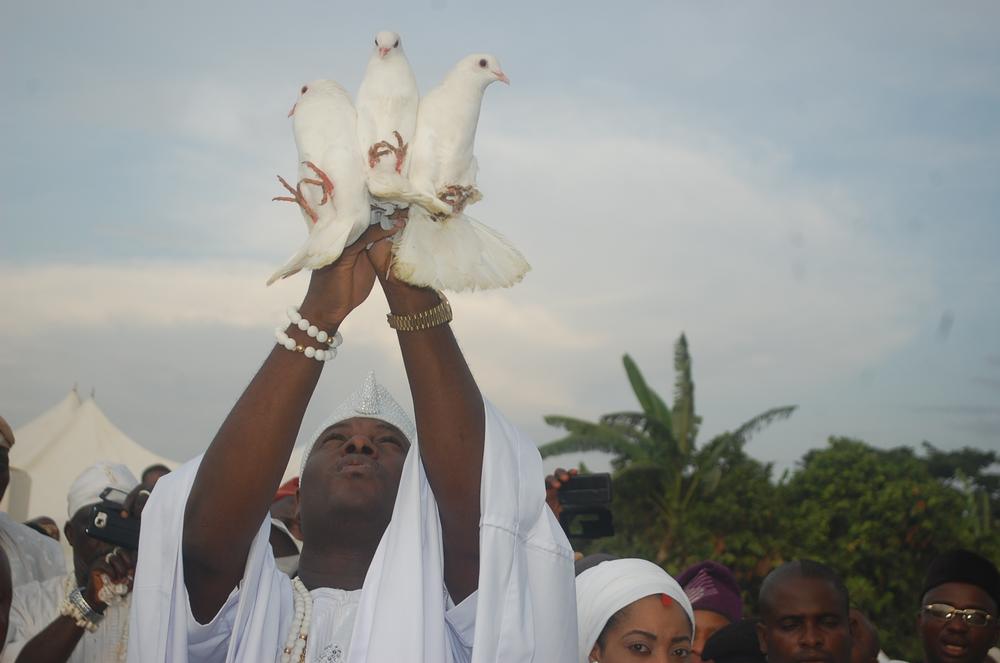
When the king dies, it is the Iyalashe who removes the heart from the chest cavity of the deceased oba and gives it to the new king who must then become a member of the Awo Gelede itself. This process explains why the real kingmaking roles are actually functions of the Great Mothers and also highlights how the Oro cult, Ogboni, Egungun and Gelede are also intricately involved in the crowning of a new king. In some other instances, the corpse of the king is dismembered and the pieces buried in different places all over the kingdom. The hierarchy of those conducting these rituals is very neat and everyone knows his or her role. In the ancient Oyo Empire, this practice has the active participation of members of the Ogboni cult and this was described thus:
‘The Ogboni priests have a part in the ceremonies following the death of a king and during the installation of his successor. In Oyo they are summoned to the palace as soon as an Alaafin has died and attend while the corpse is washed, then they cut off its head and take it to clean all the flesh from the skull. A palace official removes the heart and puts it in charge of the Otun Efa, the titled eunuch responsible for the Sango cult. During his installation, the succeeding Alaafin is taken by the Otun Efa to make a sacrifice to Sango and while with him is given a dish containing the heart of his predecessor, which he must eat. Later, he is taken to the Ogboni shrine where the Oluwo hands him the skull of his predecessor, which has been filled with a corn gruel which he must drink. This rite is said to enable his ears always to discriminate between the true and the false, and to give compelling power to his words. Thus, the death of an Alaafin cannot be concealed from the Ogboni, and his successor cannot be properly installed without their acceptance and collaboration.’
When a king ingests the organs of his dead predecessor, it is not seen as an ordinary physical process but also a spiritual one in which the new king is believed to have ingested the power and wisdom of not just the dead king but also of all the previous obas as each of them went through the same ritual as prescribed by the Great Mothers (Ajes).
This heart-eating ritual in the kingmaking process was described by Wole Soyinka (read his story HERE) in his book, Ake: The Years of Childhood. He called the heart-eating process ‘je oba’ which literally means to ‘eat the king’. Soyinka explained the when the old king died, his heart and liver were removed and fed to the new king. The importance of the liver here is that the Ajes (Great Mothers) are believed to use the livers to connect this physical plane of human existence to the realm of the spirits where they truly operate. Because the Great Mothers are involved in the ritual where hearts and livers are eaten, they are also called Ajedojokanmabi (Those Who Consume Hearts & Livers Without Vomitting) who are seen as the holders of the long livers, hearts and souls of every Yoruba king. Please note that this ritual is in no way considered to be a form of cannibalism but as a spiritual exercise necessary to connect two planes of existence. Reports of removal of the tongue have also been studied.
Because of the nature of these rituals, they are meant to be exclusive and kept from the citizenry and this glaring fact was illustrated by Soyinka when he talked of his shock and fear that the Alake of Egbaland, the same person who ‘had taken me on his lap and claimed I was his yekan (relative) had actually eaten human flesh.’ What even made Soyinka to be more confused was that instead of finding slimy tissue and blood on the mouth of the Alake, all he saw was what he called a ‘warm, crinkly smile.’
The Je Oba process is believed to confer immense spiritual powers on the new monarch, powers so broad that he is believed to become a living god. However, no matter how powerful a Yoruba king is, he can still be brought down to nothingness by the Awon Iyami Oshoronga if they unite in anger against an errant monarch. The importance and authority of these Ajes (palace women) was described thus:
‘The palace women are regarded as the kingmakers because the king can never make himself, and no other person can make a king. So, these women are powerful, superior. They can do and undo. They give authority….if you do not follow the orders of these people, those women, there isn’t anything that is possible….we do not neglect them at all. We can’t overlook them. We regard them as our mothers, as the elderly women. So they are very important in the making of the king as well as performing traditional rites and performing rituals to the deities and ancestors.’
Other aspects of the kingmaking process are also overseen by the Ajes who also make concoctions and preparations using items such as maize, iron, eggs and snails, each has its own symbolic meaning. Even the Adenla (Great Crown) is personally prepared and empowered by the Aje and one of the Iyami Oshoronga, the Iya Mosade must be present at the installation of any king for she alone can crown the Oba.
Now, let me guess the question you are about to ask, does this still continue? Well, one cannot really say but judging from recent events, one can safely assume that the practice might still be going on in secret and this is because:

As late as September 2009, Honourable Alderman Erelu Ayorinde, the Erelu Tunwase of Ode-Remo in Ogun State cried out over what happened to the corpse of the late king, His Royal Highness, Alayeluwa Kabiyesi Oba Sunday Funsho Adeolu Sataloye II, OON, JP, Alaye Ode Remo of Ogun State, Nigeria (1931 – 2008) and wrote:
''My late Kabiyesi was a distinguished elder statesman who like many monarchs, responded to the call of Almighty God and his ancestors through Ifa (eefah)/the Oracle of Orunmila – a spiritual ancient Yoruba method used to confirm heirs to the thrones in Yorubaland ... yet when he joined his ancestors/died, instead of a befitting burial, the whereabouts of his remains are still unknown.
For those who may think this from Ode Remo is an isolated case, this is far from the truth. The corpses of the following Yoruba kings also inexplicably vanished following their demise:
- His Royal Highness, Kabiyesi Oba Awofeso, the Elerunwon of Erunwon, he was a former primate of Cherubim and Seraphim Church and also a Revivalist.
- His Royal Highness, Oba Oladele Olashore, the Owaloko of Iloko Ijesha, he was a devout Anglican and a former finance minister of the Federal Republic of Nigeria.

Is that all? No. Few days after the immediate predecessor of the current Alake of Egbaland, the late HRH Oba Oyebade Lipede died in February 2005 at the age of 90 after spending 33 years on the throne, his youngest queen, Olori Bimpe, allegedly placed his corpse inside the boot of a car and fled to the private residence of the late traditional ruler at the Government Reserved Area, Ibara, Abeokuta, because the late king had made a clear demand for a Christian burial. However, the mission of the queen failed as the body was collected from her and given to the ritualists of Egbaland. It became a big fight between the kingmakers and the family of the late king. In May 2016, Chief Alani Bankole, the Seriki Jagunmolu of Egbaland and the Oluwo of Iporo Sodeke/Iporo Ake said of the incident:
‘In the days of old, nobody would dare make such move. Traditionally, as soon as an Oba joins his ancestors, his family ceases to have control. So, the Olori or family, does not have the authority to go near his remains, let alone take them away. The impasse was resolved when the kingmakers found the Oba’s remains in one of the rooms in the palace, but that was not without a thorough search. If such thing occurred, I would not blame the Olori or whoever was involved in such abomination because, as it is popularly said, if you give a hoe to a mad person, he will till the soil to his side. I think that, we, kingmakers, should take full responsibility for all the drama that happened. I make this statement on the grounds that we should have been more proactive in our responsibility for all the drama that happened ...
These and many more make some to allude to the fact that the rituals still continue. Today, the burials of Yoruba kings (and many traditional rulers in Nigeria) are very much shrouded in mystery and secrets. They are so secret that the graves or tombs of many kings are simply unknown or their burial processes were not visible to the general public but a few members. In fact in some instances, not even the queens or children of the late king are allowed to view the burial (if any) process. Following the demise of a Yoruba king, curfews are usually declared within the kingdom or beyond sometimes lasting days or weeks, for various rituals and secret rites to be held by different groups.
Although some citizens have questioned the logic behind these actions while others have queried the constitutionality of some of these practices and the influence of these traditions, time will tell who will blink first.
I personally love this digging deep piece written by Abiyamo, Its intriguing to learn some of our cultures and traditions, perhaps we may differentiate between idol worshipping and tradition. It was also learnt that the current oba of Ile-Ile didnt have to go through the eating process, as other traditional rites performed by him would still keep him protected.
THANKS FOR YOUR TIME.
Source: News7ng.com


Comments